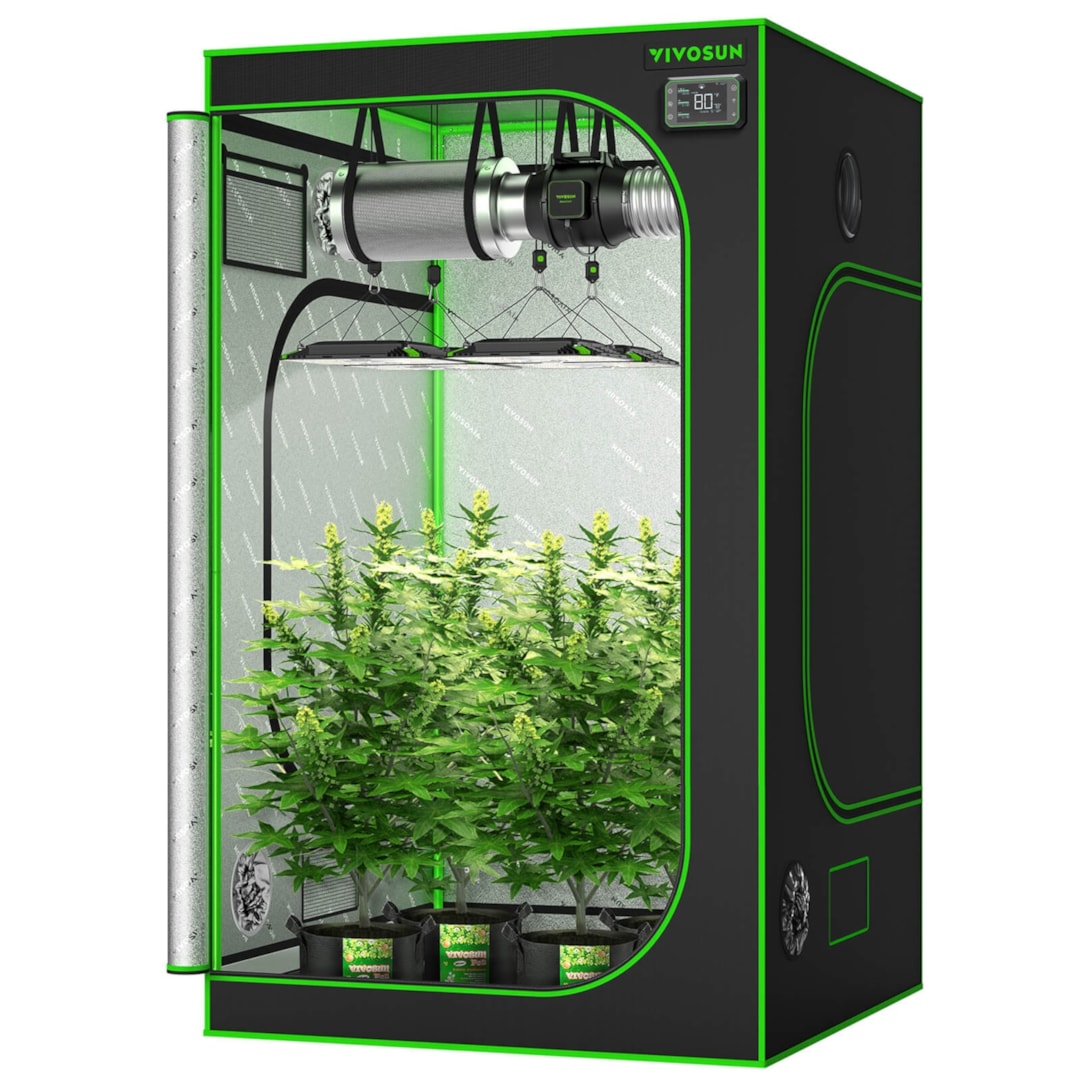
If you're setting up a 4x4 grow tent, the short answer is: most growers need somewhere between 400 and 800 actual watts of LED, depending on the growth stage and the plants you're growing. But wattage alone won't tell you whether your plants are actually getting enough usable light — a poorly designed 800W fixture can underperform a well-engineered 500W one.
Quick Answer: How Many Watts Do You Need for a 4×4 Grow Tent?
4×4 = 16 Square Feet
A 4×4 tent gives you 16 square feet of canopy space. Indoor growers commonly size their lights using a watts-per-square-foot rule:
- 25–30 watts per square foot for vegetative growth
- 30–50 watts per square foot for flowering
Watts-per-square-foot is useful as a rough starting point, but it should not be used as a standalone sizing formula for modern LED grow lights.
For a 4×4 tent, this roughly translates to 400–480W for vegetative growth and 480–800W for flowering. Use these numbers as a starting range, then verify the fixture's PPFD map and efficiency.
Recommended Wattage by Growth Stage
| Growth Stage | Typical Light Intensity | Approx. LED Power for a 4×4 Tent* |
|---|---|---|
| Seedling | Low | Use a dimmable fixture at reduced output |
| Vegetative | Moderate | 400–480W |
| Flowering | High | 480–800W |
A few notes on how to read this table:
- These numbers refer to actual power draw, not the inflated "equivalent wattage" some manufacturers advertise. A light claiming "1000W equivalent" but only pulling 250W from the wall won't deliver 4×4 coverage.
- For seedlings, focus on reducing light intensity rather than choosing a separate low-wattage fixture. A dimmable 400–600W or higher fixture can often be used throughout the entire cycle.
- For flowering plants, a target PPFD of roughly 600–1000 µmol/m²/s may be appropriate for many high-light crops. The wattage required to reach that level depends on the fixture's efficiency, coverage, hanging height, and light distribution.
What Type of Grow Light Is Best for a 4×4 Tent?
Before locking in a wattage number, it's worth understanding what you're comparing it against.
LED
LED is the standard choice for modern 4×4 setups. LEDs run cool, use significantly less electricity than older lighting technology, and can provide a full spectrum that supports every stage of growth from a single fixture. Most also offer dimming and, in higher-end models, adjustable spectrum control.
HPS
High-Pressure Sodium (HPS) lights were the industry standard for years, largely because of their raw output and red-heavy spectrum, which favors flowering. The tradeoff is heat — HPS bulbs run hot and typically require more aggressive ventilation and cooling to keep a sealed 4×4 tent from overheating.
CMH
Ceramic Metal Halide (CMH) lights sit between HPS and LED. They produce a broad, sun-like spectrum and run cooler than HPS, though still warmer than most LEDs. CMH is popular with growers who want a natural-looking spectrum without switching bulbs between growth stages.
For most home growers, LED offers the best balance of efficiency, heat management, and flexibility — which is why the rest of this guide focuses on LED wattage.
How Much Light Does Your Plant Need?
Wattage requirements shift depending on what's actually growing under the light. Here's how to think about it by plant type.
Seedlings
Seedlings and clones don't need — and can't handle — intense light. Keep intensity low (roughly 200–400 µmol/m²/s PPFD) and hang the light further from the canopy. Overpowering seedlings with high-intensity light is a common cause of stunted or stressed early growth.
Vegetative Plants
During vegetative growth, plants are building stems, branches, and leaves. A wattage of 400–480W across a 4×4 tent is typically sufficient to support strong structural growth without pushing plants into stress.
Leafy Greens & Herbs
Lettuce, spinach, basil, cilantro, and similar crops have relatively low light requirements. A lower light intensity is usually sufficient, so a dimmable 400–480W fixture can provide plenty of headroom without needing to run at full output.
Fruiting Plants
Tomatoes, peppers, and other fruiting crops need considerably more energy to fuel flowering and fruit development. A higher-output 400–800W fixture may be appropriate, depending on its PPFD performance and the target intensity.
Flowering Plants
Flowering ornamentals and cannabis both fall into the higher-demand category. A wattage range of 600–1000 PPFD (roughly 480–800W of quality LED across a 4×4 footprint) gives flowering plants the intensity they need to develop dense, well-formed blooms.
Why Wattage Isn't the Whole Story
Think of wattage as the energy input, while PPFD is the light your plants actually receive.
Wattage tells you how much electricity a light consumes — not how much usable light actually reaches your plants. A handful of other metrics matter more once you're comparing specific fixtures:
- PPFD (Photosynthetic Photon Flux Density) measures how much usable light is landing on your canopy at a given point, in µmol/m²/s.
- PPF (Photosynthetic Photon Flux) measures the total amount of usable light a fixture produces per second, regardless of where it lands.
- Efficacy (µmol/J) measures how efficiently a light converts electricity into usable plant light. A higher µmol/J means more usable light per watt consumed.
- PPFD Map shows how light intensity is distributed across the entire canopy, not just directly under the fixture. A light with strong center output but weak corners will leave part of your 4×4 tent under-lit.
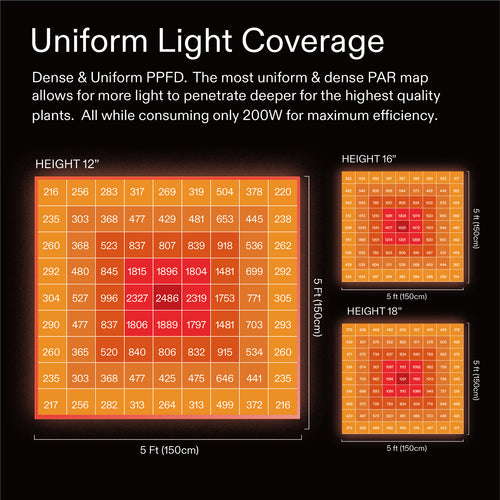
We go deeper into how to read and use these metrics in , which is worth a look if you want to compare fixtures side by side.
How to Choose a 4×4 Grow Light
Once you know your target wattage, use these factors to narrow down an actual fixture.
Coverage
Look for a fixture specifically designed to deliver the required PPFD across a 4×4 footprint. A larger coverage rating can be useful, but don't assume that a larger stated coverage area means better light intensity across your 4×4 canopy.
Full Spectrum
A full-spectrum LED provides the blue, red, and supporting wavelengths plants need across their entire life cycle, so you can use one fixture from seedling to harvest instead of swapping lights between stages.
Dimming
A dimmable driver lets you scale intensity up as plants mature, rather than committing to one fixed output. This is especially useful for growers running the same tent through multiple crop types or stages.
Light Distribution
Bar-style fixtures can make it easier to distribute light across a square canopy because multiple light bars spread the source over a larger area. However, the actual PPFD map matters more than the fixture shape alone.
Efficiency
Compare fixtures by µmol/J, not just wattage. A more efficient light delivers more usable PPFD per watt, which lowers both your electricity bill and the heat load in your tent.
Build Quality & Warranty
Look for aluminum housing for heat dissipation, quality drivers, and a manufacturer warranty of at least 2–3 years. Check the warranty period and what it covers, including parts, labor, replacement, and shipping.
One Large Light vs. Multiple Smaller Lights
You generally have two ways to light a 4×4 tent:
One high-power fixture (600–800W) centered over the tent is the simplest setup — one driver, one schedule, one thing to mount and maintain. Modern bar-style LEDs are designed specifically to cover this footprint evenly.
Two mid-power fixtures (300–400W each) positioned side by side can also work well, and offer some redundancy — if one light has an issue, you're not left in the dark. The tradeoff is more mounting hardware, more wiring, and potentially higher total system cost.
For most home growers, a single well-designed 4×4-rated fixture is the simpler and more cost-effective choice. The dual-light approach makes more sense if you're scaling up gradually or want flexibility to reposition lights for different plant layouts.
How High Should a Grow Light Hang?
Hanging distance directly affects both PPFD and coverage area — closer means more intense but a smaller footprint, farther away spreads light thinner over a wider area.
- Seedling stage: 24–36 inches above the canopy
- Vegetative stage: 18–24 inches above the canopy
- Flowering stage: 12–18 inches above the canopy
These distances should only be used as starting points because two fixtures with the same wattage can produce very different PPFD at the same height. Every fixture has a different output profile, so the manufacturer's PPFD map for your specific light will always be more accurate than a generic hanging-distance chart. If you see bleached or curling leaves, raise the light; if plants are stretching with long gaps between nodes, lower it slightly. For a closer look at reading PPFD maps and dialing in exact hanging height, see How Far Should Grow Lights Be From Seedlings?.
Heat, Ventilation, and Energy Use
More wattage means more heat, and more heat means your ventilation system has to work harder. The ventilation capacity you need depends on more than light wattage. Room temperature, tent temperature, ducting, filters, humidity, and other equipment all affect the required airflow. Choose an exhaust fan based on the total heat load and your target temperature, then account for airflow losses from ducting and filters.
A 600W fixture running for 12 hours per day uses about 216 kWh per 30-day month. Your actual cost depends on your local electricity rate. If you're moving from HID to LED, you can generally expect similar or better light delivery at meaningfully lower total wattage and electricity spend.
Smart Features for Modern 4×4 Grow Tents
Grow lights have moved well past a simple on/off switch. A few features are worth looking for if you want more consistency with less manual adjustment:
Dimming
Beyond basic on/off control, adjustable dimming lets you match intensity to each growth stage without changing fixtures.
Spectrum Control
Some fixtures let you shift the ratio of wavelengths — emphasizing blue during vegetative growth and red during flowering — rather than running a single fixed spectrum the whole cycle.
Smart Scheduling
App-based or programmable timers can automate on/off cycles, dimming ramps, and even gradual sunrise/sunset transitions, which reduce the shock of plants going from full dark to full intensity instantly.
Environmental Monitoring
Pairing your light with temperature and humidity sensors lets you catch heat stress or humidity spikes before they affect the canopy, rather than discovering the problem after the fact.
Integrated Design
One of the more overlooked upgrades in newer LED systems is design integration — combining the fixture with features like built-in ventilation ports, so you're not retrofitting extra hardware into an already tight 4×4 tent.
One example is VIVOSUN AeroLight, which integrates a circulation fan directly into the grow light. This combines lighting and canopy airflow in a single fixture, helping reduce the amount of separate equipment inside the tent. The AeroLight system also supports tunable spectrum, dimming, and smart control through compatible VIVOSUN GrowHub systems.
4×4 Grow Light Buying Checklist
Use this as a quick reference when comparing fixtures:
- Actual power draw: Is the wattage appropriate for your plants and growth stage?
- 4×4 coverage: Does the PPFD map cover the entire canopy?
- PPFD: Does it reach your target intensity?
- Efficiency: Is the efficacy listed in µmol/J?
- Dimming: Can you reduce output for seedlings and increase it later?
- Spectrum: Is it suitable for the full growth cycle?
- Light distribution: Are the edges and corners adequately illuminated?
- Heat management: Can your tent ventilation handle the system?
- Build quality: Is the driver and housing designed for long-term use?
- Warranty: Is the coverage clearly stated?
Frequently Asked Questions
What wattage LED grow light do I need for a 4×4 tent? For most 4×4 grow tents, 400–600W of quality LED lighting is a practical starting point. High-light flowering or fruiting setups may benefit from 480–800W, depending on PPFD, efficiency, coverage, and plant type.
How far should an LED grow light be from plants? Roughly 24–36 inches for seedlings, 18–24 inches during vegetative growth, and 12–18 inches during flowering. Always check the manufacturer's PPFD map for your specific fixture, since output intensity varies between models.
What PPFD do plants need in a 4×4 tent? Target 200–400 µmol/m²/s for seedlings, 400–600 µmol/m²/s during vegetative growth, and 600–1000 µmol/m²/s during flowering.
Is LED better than HPS for a 4×4 tent? For most home growers, yes. LED uses less electricity, runs cooler, and typically offers a full, adjustable spectrum from one fixture. HPS can still deliver strong flowering results, but it comes with more heat and higher long-term running costs.
Can I use one grow light for the entire growth cycle? Yes, as long as it's a full-spectrum, dimmable LED. Run it at lower intensity for seedlings and vegetative growth, then increase output as plants move into flowering.
Should I use one large light or two smaller lights? A single 600–800W fixture rated for 4×4 coverage is simpler to install and manage, and works well for most setups. Two smaller lights can offer more flexible positioning and some redundancy, at the cost of extra mounting and wiring complexity.