The short answer: For most home growers using 100–750W LED fixtures, monthly electricity costs typically range from about $7 to $100, depending on runtime and local electricity rates. That's about the price of a couple of streaming subscriptions — not exactly the bill shock some first-timers worry about.
But that number alone doesn't tell the full story. The real question isn't just "how much does it cost" — it's "how much of that electricity actually turns into plant growth?"
Two growers can both run "400-watt" lights and pay the same utility rate, yet one ends up with a $22 monthly bill and 8 ounces of flower, while the other pays $35 and harvests half as much. The difference comes down to fixture efficiency, how much heat your light dumps into your tent, and whether your setup forces you to run extra equipment just to keep the environment stable.
This guide walks through the actual numbers — not marketing fluff — including the dollars-and-cents math, the efficiency metrics that separate a good investment from an expensive space heater, and the specific VIVOSUN features that chip away at your bill month after month.
The Only Formula You Need
Every electricity cost estimate starts with the same dead-simple equation:
Monthly Cost = (Wattage ÷ 1,000) × Hours per Day × 30 Days × Your Electricity Rate
Three variables, and you control two of them:
| Variable | What It Means | Can You Change It? |
|---|---|---|
| Wattage | Actual watts pulled from the wall — not the "equivalent" number printed on the box | Yes — pick an efficient fixture, dim during early veg |
| Hours per Day | Your light schedule: typically 18 hours for veg, 12 for flower | Yes — use timers or smart scheduling |
| Electricity Rate | What your utility charges per kilowatt-hour (kWh), in cents | Sort of — time-of-use plans can cut costs if your lights run off-peak |
The U.S. residential electricity average was 17.3¢/kWh in 2025, while EIA's 2026 summer forecast is about 18.3¢/kWh. But "average" doesn't mean much when the range spans from under 11¢ (North Dakota, Nebraska, Idaho) to 36¢ (Hawaii) and 30¢+ across California and much of New England. Skip the national average. Look at your own bill.
Real Monthly Costs: From a 2×2 to a 5×5
Here's what you actually pay — not estimates, not "equivalent wattage" nonsense — based on actual wall draw at two common schedules and two realistic rate tiers.
For the Budget-Conscious Grower (13¢/kWh — Southern, Midwestern, Plains States)
| Tent Size | Realistic Wattage | Light Schedule | Monthly Consumption | Monthly Cost |
|---|---|---|---|---|
| 2×2 ft | 100W | 18 hrs (veg) | 54 kWh | $7.02 |
| 2×4 ft / 3×3 ft | 200W | 18 hrs (veg) | 108 kWh | $14.04 |
| 3×3 ft / 4×4 ft | 320W | 18 hrs (veg) | 172.8 kWh | $22.46 |
| 4×4 ft | 400W | 18 hrs (veg) | 216 kWh | $28.08 |
| 4×4 ft | 400W | 12 hrs (flower) | 144 kWh | $18.72 |
| 5×5 ft | 750W | 12 hrs (flower) | 270 kWh | $35.10 |
For the Higher-Rate Grower (25¢/kWh — California, Northeast, Mid-Atlantic)
| Tent Size | Realistic Wattage | Light Schedule | Monthly Consumption | Monthly Cost |
|---|---|---|---|---|
| 2×2 ft | 100W | 18 hrs (veg) | 54 kWh | $13.50 |
| 2×4 ft / 3×3 ft | 200W | 18 hrs (veg) | 108 kWh | $27.00 |
| 3×3 ft / 4×4 ft | 320W | 18 hrs (veg) | 172.8 kWh | $43.20 |
| 4×4 ft | 400W | 18 hrs (veg) | 216 kWh | $54.00 |
| 4×4 ft | 400W | 12 hrs (flower) | 144 kWh | $36.00 |
| 5×5 ft | 750W | 12 hrs (flower) | 270 kWh | $67.50 |
A quick gut check: Run a 400W LED in a 4×4 on an 18/6 veg schedule at the national average of 17.5¢/kWh, and you're looking at roughly $37.80/month. Flip to 12/12 for flower and it drops to about $25.20. That's your light. Your inline fan, circulation fans, and any supplemental equipment add maybe $5–$15 on top depending on what you're running.
The Efficiency Gap: Why Two 400W Lights Can Cost Dramatically Different Amounts
Here's where most "cost to run" articles get lazy. They treat all LEDs as equal and stop at the wattage math. But wattage only tells you what you pay — it doesn't tell you what your plants get.
The metric that matters is PPE: Photosynthetic Photon Efficacy, measured in µmol/J. It's the number of plant-usable photons your fixture produces per joule of electricity. Think of it like miles per gallon — two cars can burn the same tank of gas but go very different distances.
| Fixture Tier | Typical PPE | Actual Wattage Needed | Monthly Cost (12h, 17.5¢) |
|---|---|---|---|
| Budget blurple / old tech | 1.5–1.8 µmol/J | ~700W | $44.10 |
| Mid-tier full-spectrum (2023 era) | 2.2–2.5 µmol/J | ~500W | $31.50 |
| Quality 2024–2026 LED (e.g., LumaLight) | 2.7–3.0 µmol/J | ~400W | $25.20 |
Actual wattage requirements vary with fixture layout, mounting height, light distribution, tent reflectivity, and canopy uniformity.
That's a $19/month gap between a budget fixture and an efficient one — delivering the same light to your canopy. Over a single 4-month grow cycle, the efficient fixture saves you about $75 in direct lighting cost. Over two years of continuous growing? More than $450 — often more than the price difference between the fixtures in the first place.
And that's before we talk about heat.
The Hidden Bill Killer: Your Light Is Also a Heater
This is the part most growers don't think about until their first summer run. Every watt your light pulls eventually becomes heat — thermodynamics doesn't negotiate. The question is where that heat goes, and what you have to do about it.
Traditional HPS and budget LEDs dump significant heat downward toward your canopy. That means your exhaust fan runs harder, your tent temperature creeps up, and in warmer months you're fighting to keep things under 85°F instead of 78°F. Some growers add a portable AC unit to the room — and a 5,000 BTU portable AC pulls roughly 500–800W on its own. Suddenly your "400W" setup is pulling 1,200W from the wall, and your electricity math looks very different.
Better-designed fixtures manage this in three ways:
- Driver placement. When the LED driver sits outside the tent (or is designed with a remote-mount option), its heat never enters the grow space.
- Thermal design. Thick aluminum heatsinks and passive cooling fins pull heat away from the diodes and let your exhaust system carry it out efficiently.
- Integrated air movement. This is where the VIVOSUN AeroLight series takes an unusual approach — it builds a circulation fan directly into the light bar itself.
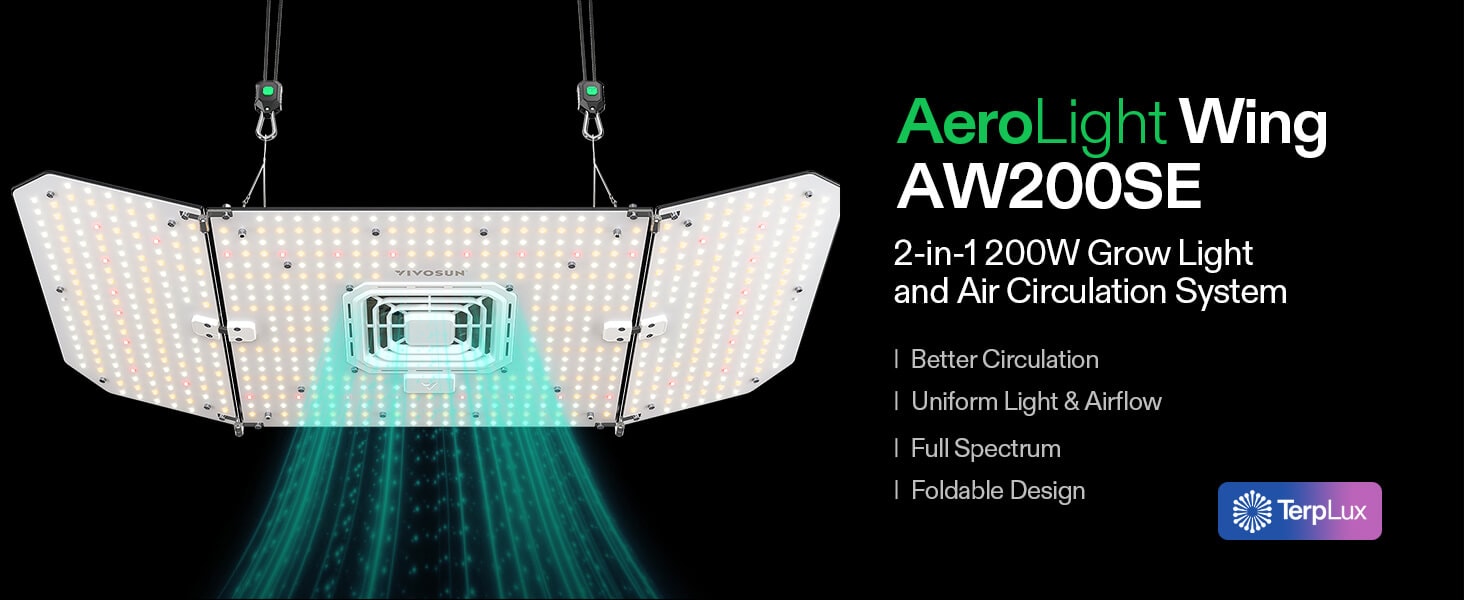
That last point matters more than it sounds. Many 4×4 setups use a separate oscillating or circulation fan, often in the 15–35W range. The AeroLight Wing AW200SE has an 84 CFM fan built into the fixture body — it pushes air across the canopy while the light runs, eliminating the need for at least one separate fan. If the integrated fan allows you to eliminate a separate 15–35W circulation fan running 24/7, that could avoid roughly 11–25 kWh of additional monthly consumption.
Real talk from a multi-year grower: The biggest electricity shock isn't the light. It's the chain reaction: light heat → higher tent temps → exhaust fan at max speed → room heats up → AC kicks in → bill doubles. Break that chain early, and everything gets cheaper.
HPS vs. LED: The Math Has Tipped Completely
Five years ago, the "LED vs HPS" debate still had some nuance. HPS was cheaper upfront and the efficiency gap was narrower. For most home growers, modern high-efficiency LEDs now have a clear operating-cost advantage over HPS, especially when electricity and cooling costs are included.
Take a classic comparison — a 4×4 flowering tent needing roughly 800–1000 PPFD across the canopy:
| 600W HPS (air-cooled hood) | VIVOSUN AeroLight 550W | Difference | |
|---|---|---|---|
| Fixture Wattage | 600W | 550W | — |
| Ballast Loss (~8%) | +48W | None (driver integrated) | — |
| Total Wall Draw | ~648W | ~550W | LED uses 38% less |
| Separate Circulation Fan | Required (30W, 24/7) | Built-in (0W extra) | +30W for HPS setup |
| Bulb Replacements (per year) | 1–2 bulbs @ $30–60 each | None for 5+ years | $60–$120/year |
| Monthly Lighting Cost (12h, 17.5¢) | $40.82 (648W) + $3.78 (fan) = $44.60 | $34.65 | Save $9.95/month |
| Cooling Load on Room | High — expect AC use in summer | Moderate — often manageable with exhaust only | Variable but significant |
Over 12 months, the LED saves about $119 in direct electricity in this example. Add an illustrative $60–$120/year for HPS bulb replacement, and the total operating-cost difference can reach roughly $179–$239 per year, before considering cooling.
The LED's higher upfront cost can be recovered over time through lower electricity and bulb-replacement costs, with the exact payback period depending on the purchase price and local electricity rate.
VIVOSUN-Specific: Features That Actually Cut Your Bill
Not every LED "feature" translates to real savings. Some are marketing. These are the ones that show up on your utility statement:
1. The Built-In Circulation Fan (AeroLight Series)
We covered this above, but let me put a fine point on it. The AeroLight series integrates a circulation fan into the fixture, helping move air directly across the canopy without requiring a separate circulation fan. You don't need to add a separate fan to your setup. The fixture's published input power already represents the device's electrical load.
2. Tunable Spectrum Without Buying a Second Light
Most growers run bluer light (more 5000K) during veg and redder light (more 3000K + 660nm deep red) during flower. With a fixed-spectrum fixture, you either compromise with one setting year-round or buy separate veg and flower lights. The AeroLight and LumaLight Next-Gen lines let you adjust spectrum from the onboard dial or the VIVOSUN app — same fixture, optimized for every stage.
Spectrum control can help growers adjust the light recipe for different growth stages without purchasing separate fixtures. The electricity savings come primarily from avoiding additional equipment purchases, not from spectrum adjustment itself.
3. Per-Stage Dimming (25%–100%)
A seedling under a 2×4 light doesn't need 400W blasting at full tilt. Cranking a powerful light to 100% and raising it 40 inches from the canopy works, but it wastes electricity lighting the walls, floor, and anything that isn't a leaf. The VIVOSUN dimming dial (and app control via GrowHub) lets you run 25% or 50% power during early veg, gradually stepping up as the canopy fills in. For the first 2–3 weeks of a grow, you might use half the electricity you'd otherwise burn.
A quick real-numbers example: Say you run a 200W AW200SE in a 2×4 tent. Full 18-hour veg schedule for 4 weeks. If you run weeks 1–2 at 50% (100W) and weeks 3–4 at 75% (150W) instead of 100% the whole time:
- 100% all 4 weeks: 200W × 18h × 28 days = 100.8 kWh = $17.64 (at 17.5¢)
- Stepped dimming: (100W × 18h × 14d) + (150W × 18h × 14d) = 25.2 + 37.8 = 63 kWh = $11.03
The E25 itself is rated at 3W. Even if it operated continuously for a full year, that would be about 26 kWh, or roughly $4.60 at 17.5¢/kWh.
4. Smart Scheduling via GrowHub
This one's less obvious but compounds over time. The VIVOSUN GrowHub Controller (E42A or E25) lets you program exact on/off times, ramp the light up and down gradually (sunrise/sunset simulation), and tie your light schedule to temperature and humidity triggers. The main electricity benefit is more precise scheduling and dimming: you can set operating periods and reduce light output when full intensity isn't necessary.
3 Questions Every New Grower Asks About Electricity Costs
Q: Will a grow light double my electricity bill?
A: No — not even close for a typical home setup. The average U.S. household uses roughly 1,000–1,100 kWh of electricity per month, although usage varies significantly by season and region. A 400W LED on an 18/6 schedule in a 4×4 tent adds roughly 216 kWh — about a 20-22% increase, not 100%. A smaller 200W 2×4 setup adds about 108 kWh (~12% increase). If you're in a high-rate state, the percentage increase is the same but the dollar amount stings more — which is exactly why fixture efficiency matters.
Q: LED or HPS — which actually costs less over a full year?
A: LED, and by a widening margin. A well-designed 400W high-efficiency LED can deliver comparable photon output to a substantially higher-wattage HPS fixture, depending on fixture efficacy and light distribution. AAdd ballast losses on the HPS (~8%), a required circulation fan (30W extra), and bulb changes ($60–$120/year), and the LED can save roughly $290–$350 per year in this example, before cooling costs. The LED's higher upfront cost is recovered within 6–10 months.
Q: What's the single biggest thing I can do to lower my grow light bill?
A: Buy a fixture with a PPE of 2.7 µmol/J or higher and run it dimmed during early veg. A high-PPE fixture can reduce the power required to deliver a given photon output, while dimming can further reduce consumption when full intensity isn't necessary. The exact savings depend on your target PPFD, fixture design, and growing conditions. Second-biggest: use a timer or smart controller so your light never drifts past its scheduled off time. Sounds obvious, but you'd be surprised how many growers lose an extra 30–60 minutes of runtime per day to "I'll shut it off after this episode" syndrome.
Q: How much does it cost to run a 400W grow light?
A: A 400W grow light uses about 216 kWh per month on an 18-hour schedule and 144 kWh on a 12-hour schedule. At 18¢/kWh, that's about $38.88 per month for 18 hours/day or $25.92 for 12 hours/day.
Quick Reference: Your Setup, Your Cost
Find your tent size, grab your utility rate from your last bill, and cross-reference:
| Your Tent | Recommended VIVOSUN Light | Actual Wattage | Veg (18h) at 13¢ | Veg (18h) at 18¢ | Veg (18h) at 25¢ | Flower (12h) at 18¢ |
|---|---|---|---|---|---|---|
| 2×2 ft | LumaLight 100W | 100W | $7.02 | $9.72 | $13.50 | $6.48 |
| 2×4 / 3×3 ft | AeroLight Wing AW200SE | 200W | $14.04 | $19.44 | $27.00 | $12.96 |
| 3×3 ft | LumaLight Next-Gen 320W | 320W | $22.46 | $31.10 | $43.20 | $20.74 |
| 4×4 ft | AeroLight LED 550W | 550W | $38.61 | $53.46 | $74.25 | $35.64 |
| 5×5 ft | LumaLight Next-Gen 750W | 750W | $52.65 | $72.90 | $101.25 | $48.60 |
Rates shown in cents per kWh. Check your bill — most utility statements list your effective rate (total bill amount ÷ total kWh used) somewhere on page 2 or 3.
The Bottom Line
There's a lot of noise online about grow light electricity costs — everything from "it's basically free" to "my bill tripled and my landlord noticed." The reality, as usual, is somewhere in the middle and entirely knowable with two minutes of math.
A quality 200–750W LED fixture in a typical home grow tent can cost roughly $13 to $100 per month in most of U.S., depending on wattage, schedule, and electricity rates. That figure drops during flower (shorter photoperiod) and during early veg (dimmed). The right fixture pays for itself in efficiency savings within a year and keeps paying out for 50,000+ hours after that.
The growers who get surprised by electricity costs aren't necessarily the ones using lower-wattage fixtures. They're often the ones who buy lights based on inflated "equivalent wattage" labels rather than actual wall draw and photon efficacy.
Get the math right upfront. Buy a fixture where the efficiency numbers are published and verifiable. Run it on a schedule. The bill takes care of itself.
Have questions about which VIVOSUN light fits your space and budget? Check out our LED Grow Light Buying Guide for a side-by-side breakdown of every current model, or reach out to us on Reddit Community — we read and respond to every one.
Methodology & Notes: All cost calculations use the formula (Wattage ÷ 1,000) × Hours × 30 days × Rate. VIVOSUN product wattages reflect published input power. Electricity-rate references are based on U.S. Energy Information Administration data available in 2026. HPS ballast loss estimates are based on typical magnetic-ballast efficiency; digital ballasts may perform slightly better. Your actual costs will vary based on local rates, ambient temperature, ventilation setup, and growing conditions.