So, how far should a grow light be from seedlings?
As a starting point, many seedlings can be grown with a light positioned about 4–12 inches above the canopy, but the ideal distance depends on the fixture, its output, dimming level, and the amount of light reaching the leaves. For modern LED grow lights, PPFD at the canopy is a more useful measurement than distance alone.
This guide explains how to set grow light height, choose an appropriate intensity, understand PPFD and DLI, and recognize when your seedlings need more or less light.
🌿 How Far Should Grow Lights Be From Seedlings?
⚠️ Key Rule: There is no single distance that works for every grow light. Different fixtures can produce vastly different light intensities at the exact same height.
Practical Starting Distance Guide
| Grow Light Type | Starting Distance From Seedlings | Typical Seedling Use |
|---|---|---|
| T5 fluorescent / LED linear lights | 4–12 in. | Seed starting and early growth |
| Low-output LED grow bars | 6–12 in. | Seedlings and small trays |
| Full-spectrum LED panels | 12–24+ in. | Seedlings through vegetative growth |
| HID grow lights | 24–36+ in. | Generally better suited to mature plants |
These distances are starting points, not fixed specifications. A high-output LED panel may need to be much farther away than a low-power LED bar, while a dimmable fixture can often be adjusted without significantly changing its coverage.
For the most accurate setup, check the manufacturer's PPFD map when available and measure PPFD at canopy height.
For general seedlings, a practical starting target is often around 100–300 μmol/m²/s PPFD, although the ideal intensity varies by plant species, growth stage, photoperiod, and overall daily light exposure.
Key takeaway: Don't choose light height based on inches alone. Use distance as a starting point, then adjust based on PPFD, plant response, coverage, and the manufacturer's recommendations.
🌿Why Grow Light Distance Matters for Seedlings
Young seedlings are particularly sensitive to light intensity because they have small leaves, developing root systems, and limited reserves.
The goal is to provide enough light to support compact, healthy growth without overwhelming the plants.
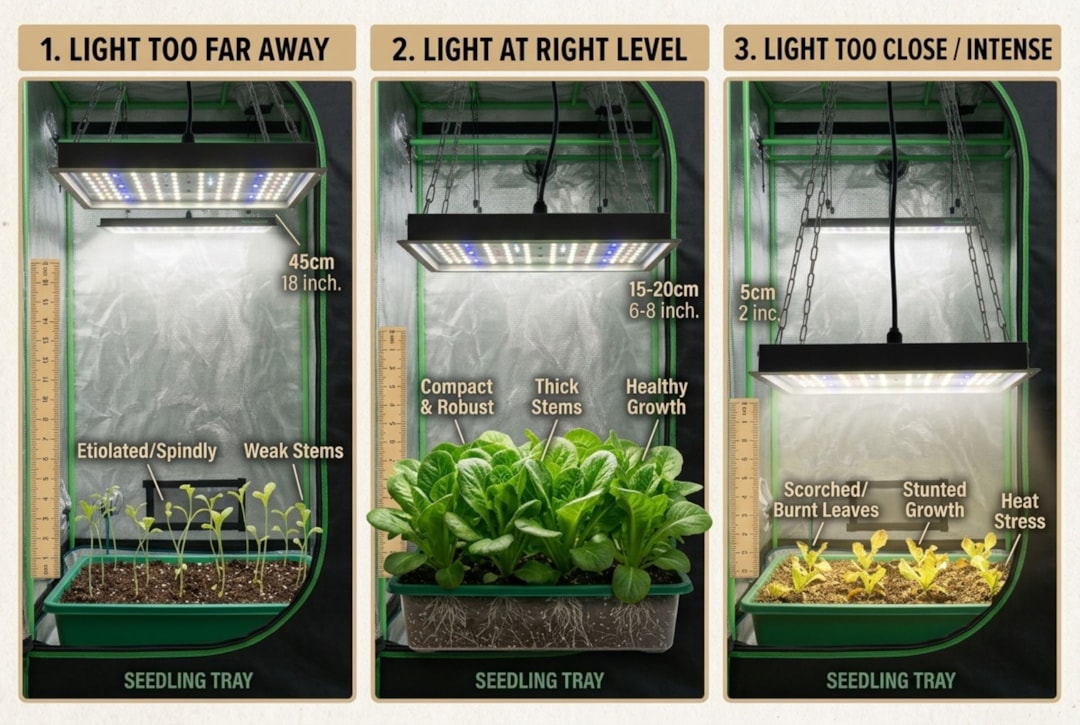
If the light is too far away
Seedlings may receive insufficient light and respond by growing toward the light source. Common signs include: Long, thin stems; Large gaps between leaves; Seedlings leaning toward the light; Pale or weak-looking growth; Uneven growth across the tray
Insufficient light is one of the most common causes of leggy seedlings.
If the light is too close or too intense
Excessive light can also cause problems, particularly when combined with high temperatures.
Possible signs include: Pale or bleached leaves; Brown or damaged leaf areas; Curling leaves; Reduced growth; Visible light stress
If you notice these symptoms, raise the light, reduce its intensity with a dimmer, or check the temperature around the canopy before making further adjustments.
If the light is at the right level
Healthy seedlings generally show: Compact stems; Upright growth; Even green coloration; Consistent growth across the canopy; No obvious bleaching or curling
The exact appearance varies by plant species, so use the plant's overall response rather than a single symptom to determine whether the lighting is appropriate.
🌿How Far Should an LED Grow Light Be From Seedlings?
LED grow lights vary considerably in power, beam angle, optics, and efficiency, so there is no universal LED hanging height.
For low-output LED grow bars, 6–12 inches above the canopy can be a reasonable starting point.
For higher-output LED panels, 12–24 inches or more may be more appropriate, particularly when the fixture is operated at full power.
If your LED has a dimmer, you have another way to control intensity. Instead of moving a high-output fixture very far away, you can often keep it at a reasonable height for good coverage and reduce the brightness.
Always check the manufacturer's recommended hanging height and PPFD map when available.
🌿How Far Should a T5 Grow Light Be From Seedlings?
T5 fluorescent fixtures and low-output linear LED lights can generally be positioned closer to seedlings than high-powered LED panels.
A practical starting range is 4–12 inches above the canopy, with the exact distance depending on fixture output and heat.
For traditional fluorescent fixtures, extension guidance commonly recommends keeping the light only a few inches above seedlings and raising the fixture as the plants grow. University of Minnesota Extension, for example, recommends approximately 4–6 inches for seedlings under certain fluorescent setups.
For LED linear lights, the same principle applies: start within the manufacturer's recommended range and monitor the canopy rather than assuming every linear fixture should be at exactly the same height.
🌿Grow Light Distance vs. PPFD
Distance tells you where the light is positioned.
PPFD tells you how much photosynthetically active light is actually reaching the plant.
PPFD stands for Photosynthetic Photon Flux Density and is measured in μmol/m²/s. It describes the amount of photosynthetically active radiation reaching a given surface each second.
As a light moves farther away from the canopy, PPFD generally decreases. However, the exact change depends on the fixture's design, optics, power, and distribution.
This is why two grow lights can both be positioned 12 inches above seedlings but deliver completely different amounts of light.
Practical PPFD Starting Range for Seedlings
A useful starting range for many indoor seedlings is:
| Growth Stage | Approximate PPFD Starting Range |
|---|---|
| Newly emerged seedlings | 100–200 μmol/m²/s |
| Established seedlings | 150–300 μmol/m²/s |
| Stronger young plants | 200–300+ μmol/m²/s |
These are general starting ranges rather than universal requirements. Different species have different light requirements, and PPFD should always be considered together with photoperiod and DLI.
Research on young plants has used a much wider range of PPFD levels depending on species and production goals, which is another reason not to treat one number as a universal target.
Why Watts Are Not Enough
A grow light's wattage tells you how much electrical power it consumes. It does not directly tell you how much usable light reaches the plant.
For example:
- A 30W LED bar
- A 100W LED panel
- A 300W LED panel
can all have very different PPFD values at the same hanging height.
When comparing grow lights, look for PPFD data, PPF output, coverage information, and manufacturer light maps rather than relying on wattage alone.
🌿How to Set Grow Light Height Without a PAR Meter
A PPFD meter is the most direct way to measure light intensity at the canopy, but not every home grower has one.
If you don't have a meter, use this three-step approach.
1. Check the manufacturer's PPFD map
If your grow light manufacturer provides a PPFD chart, use it as your primary reference. Look for measurements taken at different hanging heights, such as: 12, 18, 24, 30 inches. Pay attention to both the center PPFD and the values around the edges of the coverage area.
2. Start at the recommended height
Set the light according to the manufacturer's instructions. Do not assume that a fixture should be positioned at the same distance as another grow light simply because both are labeled "full spectrum" or have similar wattage.
3. Watch the seedlings
After establishing the starting height, observe the plants over several days. If seedlings are stretching significantly toward the light, the intensity may be too low or the fixture may be too far away. If leaves become unusually pale, bleached, curled, or otherwise stressed, the light may be too intense or too close.
Make small adjustments rather than moving the fixture dramatically.
🌿Grow Light Height and Intensity by Growth Stage
As seedlings develop, their light requirements change. Instead of keeping the light at one fixed distance throughout the entire growing cycle, adjust the fixture as the canopy develops.
| Growth Stage | Typical Light Duration | Practical PPFD Starting Range | General Height Guidance |
|---|---|---|---|
| Germination before emergence | Follow species requirements | — | No grow light required until emergence in many cases |
| Newly emerged seedling | 14–18 hrs/day | 100–200 μmol/m²/s | Keep fixture within its recommended seedling range |
| Established seedling | 14–18 hrs/day | 150–300 μmol/m²/s | Adjust height or dimming as plants grow |
| Early vegetative growth | 14–18 hrs/day | 200–400+ μmol/m²/s | Increase intensity gradually |
| Later vegetative growth | Species-dependent | 300–600+ μmol/m²/s | Follow the fixture's PPFD map and plant response |
The ranges above should not be interpreted as universal targets for every plant species.
For example, research-based indoor production systems can use different combinations of PPFD and photoperiod depending on crop species and production objectives.
Raise the Light as the Canopy Grows
If you use a fixture without a dimmer, raising the light as the plants grow can help maintain an appropriate intensity. If the fixture is dimmable, you can also adjust brightness while maintaining a useful hanging height.
The goal is not to keep the fixture at a specific number of inches. The goal is to maintain an appropriate light intensity across the canopy.
🌿What Is DLI and Why Does It Matter?
PPFD tells you how much light reaches the canopy at a given moment.
DLI, or Daily Light Integral, tells you how much photosynthetically active light the plant receives over an entire 24-hour period.
This distinction matters because the same PPFD can produce a very different daily light exposure depending on how many hours the light is on.
For example, a lower PPFD over a longer photoperiod can produce a similar DLI to a higher PPFD over a shorter photoperiod.
A commonly used conversion is:
DLI = PPFD × hours of light × 0.0036
For example, 200 μmol/m²/s for 16 hours produces a DLI of approximately 11.5 mol/m²/day.
DLI requirements vary by species and production stage. Michigan State University research and extension materials commonly discuss DLI as an important way to evaluate light exposure for young plants.
For home growers, this means that PPFD, photoperiod, and plant response should be considered together rather than treating light intensity as a single number.
🌿How Many Hours Should Seedlings Get Under Grow Lights?
For general indoor seedlings, 14–18 hours of light per day is a practical range, with many extension recommendations using approximately 16–18 hours.
University of Minnesota Extension currently recommends 16–18 hours of light per day for seedlings, while other extension guidance uses shorter ranges depending on the crop and growing situation.
The exact photoperiod depends on the plant species.
A timer is recommended because it provides a consistent light-dark cycle.
Do Seedlings Need 24 Hours of Light?
Not usually.
Keeping grow lights on continuously is not necessary for most seedlings. Many plants benefit from a daily dark period, and continuous lighting can increase energy use without providing a corresponding benefit.
Instead of automatically using 24 hours of light, start with a consistent photoperiod appropriate for the plant species and adjust the intensity and duration as needed.
🌿Should You Raise the Grow Light or Dim It?
If your grow light has a dimmer, you generally have two ways to reduce light intensity:
- Raise the fixture.
- Reduce the brightness.
These approaches are not identical.
Raise the light when:
- You need wider coverage
- The center of the canopy is receiving too much light
- You want to increase the illuminated area
- The fixture is creating excessive heat near the canopy
Dim the light when:
- Coverage is already appropriate
- The fixture has enough output for the growing area
- Seedlings are receiving excessive intensity
- You want to maintain a consistent hanging height
For a high-output LED panel, keeping the fixture at a reasonable height and using the dimmer can sometimes provide better coverage than simply moving the fixture much farther away.
🌿How to Tell if Your Grow Light Is Too Close or Too Far
Use the table below as a troubleshooting guide.
| Plant Response | Possible Cause | What to Try |
|---|---|---|
| Long, thin stems | Insufficient light | Lower the light or increase intensity |
| Seedlings lean toward the light | Insufficient or uneven light | Lower the fixture or improve coverage |
| Pale or bleached leaves | Excessive light | Raise or dim the fixture |
| Curling leaves | Excessive light, heat, or another stress factor | Check temperature and reduce intensity if necessary |
| Brown or damaged leaf areas | Excessive light or heat | Raise/dim the light and check canopy temperature |
| Healthy, compact growth | Light level is likely appropriate | Keep the current setup |
| Center grows well but edges stretch | Uneven coverage | Adjust height, spacing, or fixture coverage |
Remember that light is only one possible cause of plant stress. Watering, temperature, humidity, nutrition, root health, airflow, and disease can produce similar symptoms.
Do not diagnose a problem based on one symptom alone.
🌿Why Are My Seedlings Stretching Under a Grow Light?
Stretching, also called leggy growth, is often associated with insufficient light.
If seedlings are growing tall and thin or leaning toward the light source, check:
- How far the fixture is from the canopy
- Whether the fixture is powerful enough for the growing area
- Whether the light is dimmed too much
- Whether the entire tray is receiving even coverage
- How many hours the light is running each day
If the fixture is too far away, gradually lower it.
If the fixture is already at the recommended height but seedlings continue stretching, the fixture may not provide enough intensity or coverage.
🌿Can Grow Lights Be Too Close to Seedlings?
Yes.
A grow light can be too close when it delivers more intensity than the seedlings can tolerate or when it creates excessive heat around the canopy.
This is particularly important with high-output LED panels and HID fixtures.
However, distance alone does not determine whether a light is too close.
A low-output LED bar may work well only a few inches above seedlings, while a high-output LED panel may need to be considerably farther away.
Use the manufacturer's recommendations and, when possible, measure PPFD at canopy height.
🌿Grow Light Distance for Different Types of Fixtures
| T5 and LED Linear Grow Lights | Full-Spectrum LED Panels | HID Grow Lights |
|---|---|---|
| • Linear fixtures are commonly used for seed starting because they can provide relatively even coverage across trays and shelving. • A practical starting distance is often 4–12 inches, depending on output. • Keep the fixture close enough to prevent seedlings from stretching, but monitor the leaves for excessive light or heat. | • LED panels vary substantially in output. • A practical starting point for seedlings is often 12–24 inches, but high-output panels may need to be positioned farther away or dimmed. • Always prioritize the manufacturer's PPFD chart over a generic distance recommendation. | • HID fixtures such as high-pressure sodium and metal halide lamps generally produce substantially more radiant heat than many modern LED fixtures. • For that reason, they are usually less convenient for starting delicate seedlings. • If HID lighting is used, follow the fixture manufacturer's minimum hanging distance and pay close attention to canopy temperature. |
🌿Cannabis Seedlings Under Grow Lights
Cannabis seedlings have some lighting considerations that differ from general vegetable, herb, and ornamental seedlings.
The most important distinction is that cannabis growers often use longer photoperiods after germination, while many general seedlings are grown under approximately 14–18 hours of light per day.
What PPFD Do Cannabis Seedlings Need?
A practical starting point for young cannabis seedlings is often around 100–300 μmol/m²/s PPFD, followed by gradual increases as plants become established.
The exact target depends on:
- Cultivar
- Plant age
- Light fixture
- Photoperiod
- Temperature
- CO₂ availability
- Overall growing environment
Do not assume that increasing PPFD always produces faster or healthier growth.
What Light Schedule Should Cannabis Seedlings Use?
Cannabis growers commonly use schedules such as 18 hours of light and 6 hours of darkness during early growth.
Autoflowering and photoperiod cultivars may be managed differently depending on the grower's objectives.
The key point is that these schedules are cannabis-specific practices and should not be treated as universal recommendations for all seedlings.
🌿Recommended VIVOSUN Linear Grow Lights for Seedlings
For growers starting seeds on shelves, racks, or small indoor growing areas, linear grow lights can provide convenient coverage close to the canopy.
VIVOSUN's T5 linear grow light lineup includes 1FT and 2FT options in different wattages and pack sizes.
| Model | Products | Wattage | Pack | Best For |
|---|---|---|---|---|
| VIVOSUN T5 Grow Light, 1FT, 28W (4×7W), 4-Pack | 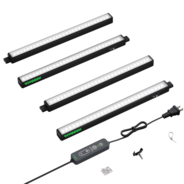 | 28W | 4-pack | Small seed trays and narrow shelves |
| VIVOSUN T5 Grow Light, 1FT, 56W (8×7W), 8-Pack | 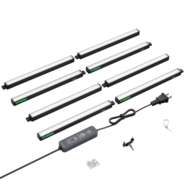 | 56W | 8-pack | Multiple small trays |
| VIVOSUN T5 Grow Light, 2FT, 60W (4×15W), 4-Pack | 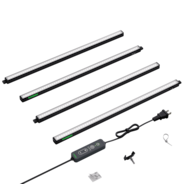 | 60W | 4-pack | Larger seed-starting trays |
| VIVOSUN T5 Grow Light, 2FT, 120W (8×15W), 8-Pack | 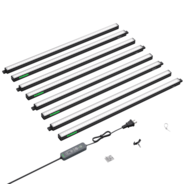 | 120W | 8-pack | Larger racks and multiple trays |
These fixtures use full-spectrum LEDs and are designed for close-range indoor growing applications.
The appropriate hanging height should still be determined according to the fixture's output, the manufacturer's specifications, and the response of the seedlings.
For more options, explore the VIVOSUN LED Linear Grow Lights collection.
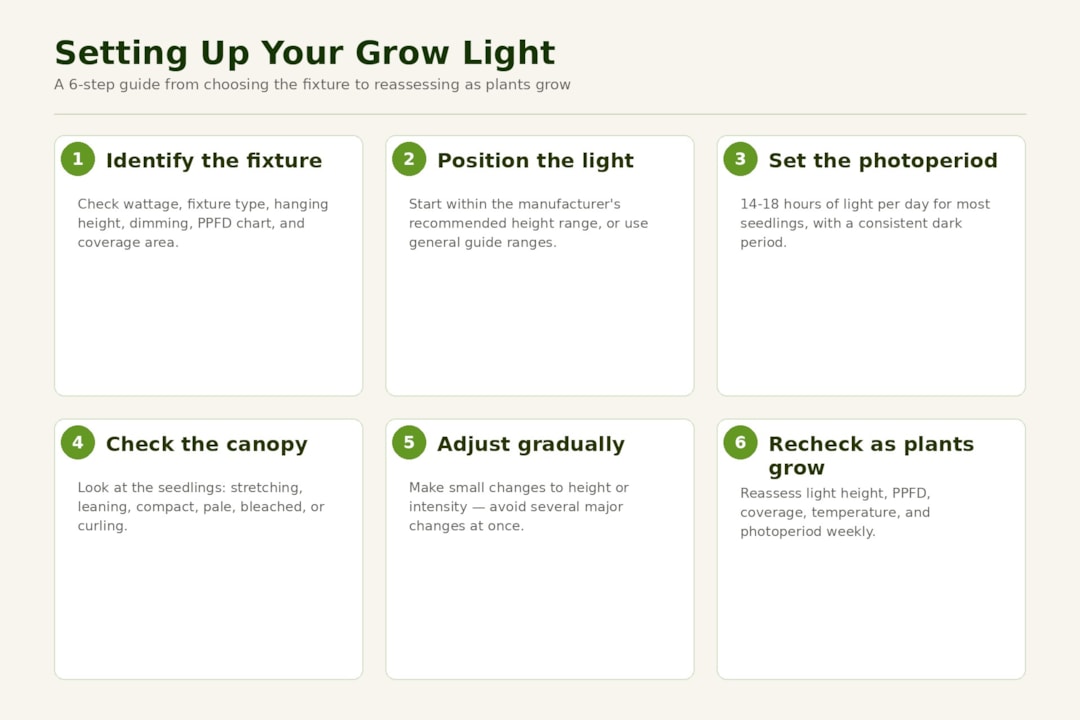
How to Set Up Grow Lights for Seedlings: A Simple Process
If you're setting up a grow light for the first time, use this process.
Frequently Asked Questions
How far should an LED grow light be from seedlings?
A low-output LED grow bar can often start around 6–12 inches above seedlings, while a higher-output LED panel may need to be 12–24 inches or more away. The exact distance depends on the fixture's output and dimming level. When available, use the manufacturer's PPFD map to determine the best height.
How far should a T5 grow light be from seedlings?
A T5 or similar linear fixture can often be positioned approximately 4–12 inches above seedlings, depending on its output and heat. Traditional fluorescent fixtures may be positioned only a few inches above seedlings, while some LED linear fixtures have different recommended distances. Follow the fixture manufacturer's specifications.
What PPFD do seedlings need?
A practical starting range for many indoor seedlings is approximately 100–300 μmol/m²/s PPFD. However, plant species, age, photoperiod, and DLI all affect the ideal intensity. Use the range as a starting point rather than a universal requirement.
Can grow lights be too close to seedlings?
Yes. Excessive light intensity or heat can cause pale, bleached, curled, or damaged leaves. If you see signs of light stress, raise the fixture or reduce its intensity and check the canopy temperature.
What happens if seedlings don't get enough light?
Seedlings may become tall, thin, weak, or lean toward the light. If this happens, check whether the fixture is too far away, dimmed too much, underpowered for the growing area, or providing uneven coverage.
Should I raise the light or dim it?
If your fixture has a dimmer, either option can work. Raising the light can increase coverage, while dimming can reduce intensity without changing the illuminated area as much. For high-output LED panels, dimming is often useful when the fixture already provides good coverage.
How many hours a day should seedlings get light?
Many general seedlings do well with approximately 14–18 hours of light per day, with 16–18 hours being a common recommendation. Requirements vary by species, so check the growing instructions for the specific plant. A timer can help maintain a consistent schedule.
Do seedlings need 24 hours of light?
Generally, no. Continuous lighting is not necessary for most seedlings. Providing a consistent daily dark period is a better general approach unless a specific crop or production system calls for a different schedule.
Is PPFD better than lux for grow lights?
PPFD is generally more useful for evaluating grow-light intensity because it measures photosynthetically active photons reaching the plant. Lux measures brightness according to human visual sensitivity and does not directly represent plant-usable light.
Is wattage a good way to determine grow light distance?
No. Wattage measures electrical power consumption rather than the amount of usable light reaching the canopy. Two fixtures with the same wattage can have very different PPFD output and coverage. Use PPFD data and manufacturer recommendations whenever possible.
When should I raise my grow light?
Raise or dim the fixture when the canopy begins receiving excessive intensity, when plants grow into the light's recommended distance, or when heat becomes a concern. Continue checking the canopy as plants grow rather than waiting for visible damage.
Final Takeaway
The best grow light distance for seedlings is not a single number.
As a starting point, many seedlings can be grown with linear fixtures positioned roughly 4–12 inches above the canopy and LED panels around 12–24 inches or more, but the correct height depends on the fixture's output, optics, dimming level, coverage, and plant response.
For a more precise setup:
- Start with the manufacturer's recommended height.
- Check the PPFD at canopy level when possible.
- Use approximately 100–300 μmol/m²/s as a practical starting range for many young seedlings.
- Provide an appropriate photoperiod, commonly around 14–18 hours for general seedlings.
- Watch for stretching, leaning, bleaching, curling, and other signs of light stress.
- Adjust height or intensity gradually as the canopy develops.
The goal isn't to keep your grow light a specific number of inches from the plant. The goal is to provide the right amount of light, evenly across the canopy, for the plant's growth stage.
If you are still not sure how far should your grow lights be from your seedlings, you can message our Reddit Community and we’ll help you out! We’re glad you’re on this journey and we want to help in any way we can.