Good ventilation is the difference between a tent full of strong, healthy plants and one plagued by heat stress, mold, and mildew. But most growers ask the same question: how long should the fan actually run each day?
Quick answer: Run your exhaust fan continuously while your grow lights are on. During the dark cycle, gradually reduce fan speed starting ~20 minutes after lights-off, stepping it down over about 3 hours until it's off (inline fans) or left on low (oscillating fans). Seedlings need gentle 24/7 airflow; vegetative and flowering plants need max airflow during lights-on.
Below, we break this down by growth stage, explain how to size your fan with a simple CFM formula, and walk through setting up the ventilation system from scratch.
Why ventilation matters
Outdoors, plants are constantly moved by wind — a form of natural ventilation. Indoors, you have to recreate those conditions mechanically. A grow tent fan does three jobs at once:
1. Controls temperature. Grow lights generate both convective and radiant heat, and a sealed tent can climb past 80°F quickly. A dedicated thermometer/hygrometer is worth adding alongside your fan so you're not guessing.
2. Controls humidity. Plants release water vapor as a byproduct of photosynthesis. In a stagnant, enclosed space that moisture builds up fast, and excess humidity is one of the leading causes of mold and pest problems in tents.
3. Replenishes CO₂. Photosynthesis consumes the CO₂-rich air around your plants faster than a sealed tent can replace it. Exhaust ventilation pulls in fresh air and pushes stale air out, keeping CO₂ levels from bottoming out.
How to calculate the CFM you need
Start by calculating your grow tent's volume:
Length × Width × Height = Tent Volume (cubic feet)
As a basic air-exchange estimate, divide your tent volume by 3 to determine the baseline CFM (cubic feet per minute).
Baseline CFM = Tent Volume ÷ 3
For example, a 107-cubic-foot tent has a baseline requirement of:
107 ÷ 3 ≈ 36 CFM
Your actual fan requirement may need to be higher because ducting, carbon filters, and grow lights can increase airflow resistance or heat load.
| Factor | Recommended adjustment |
|---|---|
| Each 90° duct bend | +40–60% |
| Carbon filter | +~60% |
| LED grow lights / heat load | +50% |
Using the example above, if the setup includes one 90° duct bend, a carbon filter, and LED grow lights:
36 × 1.6 × 1.6 × 1.5 ≈ 138 CFM
So the system would need approximately 138 CFM of effective airflow under these assumptions.
Important: Check the fan's actual airflow performance
The calculated CFM is an estimate rather than a universal requirement. The actual fan you need depends on factors such as duct length, the number of bends, filter resistance, ambient temperature, and the fan's performance under static pressure.
When choosing an inline fan, don't compare only the fan's maximum or "free-air" CFM rating. Choose a fan that can provide sufficient airflow after accounting for the resistance of your actual ventilation system.
Tip: minimize 90° bends in your ducting wherever you can — every bend adds real resistance and cuts into your fan's rated CFM.
Fan size chart by tent size
| Tent Size(ft) | Size(W x L x H) | Recommended Duct Fan |
|---|---|---|
| grow tent 2×2 | 24"×24"×48" | AeroZesh T4 Inline Fan (4") |
| grow tent 2×3 | 24″×36″×53″ | AeroZesh G4 Inline Fan (4") |
| grow tent 3×3 | 36"×36"×72" | AeroZesh G4 Inline Fan (4") |
| grow tent 4×2 | 48"×24"×72" | AeroZesh T4 Inline Fan (4") |
| grow tent 4×4 | 48"×48"×80" | AeroZesh T6 Inline Fan (6") |
| grow tent 3×4 | 36″×48″×72″ | AeroZesh T6 Inline Fan (6") |
| grow tent 2×5 | 60"×32"×80" | AeroZesh G6 Inline Fan (6") |
| grow tent 5×5 | 60"×60"×80" | AeroZesh T8 Inline Fan (8") |
| grow tent 8×8 | 96"×96"×80" | AeroZesh T8 / G8 Inline Fan (8") |
| grow tent 5×10 | 120"×60"×80" | AeroZesh T8 / G8 Inline Fan (8") |
Model availability changes over time — check current specs and CFM ratings on the manufacturer's site before buying, since lineups get refreshed periodically.
Ventilation schedule: light vs. dark cycle
Lights on: Keep the fan running continuously. Most fans include a speed controller — dial it in based on tent temperature, natural airflow from any oscillating fans (run those at max speed), and humidity readings.
Lights off: Temperature will drop gradually once the lights shut off, but you still need airflow for a while:
- Inline fans: Begin reducing speed about 20 minutes after lights-off, then keep stepping it down over the next ~3 hours until it's fully off.
- Oscillating fans: Slow them down for the dark cycle, but leave them running all night rather than switching off.
Ventilation schedule by growth stage
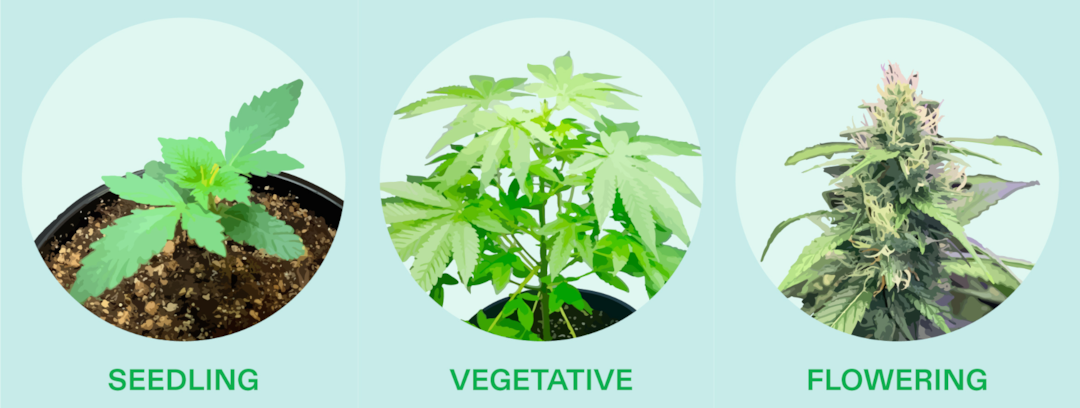
Seedling stage: Run the fan 24/7 at a gentle setting — seedlings are fragile and shouldn't be blasted with direct airflow. Pair your inline fan with a soft oscillating fan for gentle circulation. Keep airflow gentle and avoid directing strong airflow directly at seedlings.
Vegetative stage: Plants are sturdy enough now for strong, direct airflow, which actually encourages thicker stems and more resilient growth. Run the inline fan at max during lights-on and use the dark-cycle step-down described above. Keep an oscillating fan running as well.
Flowering stage: During flowering, maintain adequate airflow through the dark cycle and reduce the exhaust rate only as temperature and humidity allow.
How to set up your ventilation system (8 steps)
Step 1 — Size your exhaust fan. Calculate tent volume (L × W × H). Under 100 cu. ft.: a 4–6" fan rated 200+ CFM. Larger tents: a 6–8" fan rated 400–800 CFM.
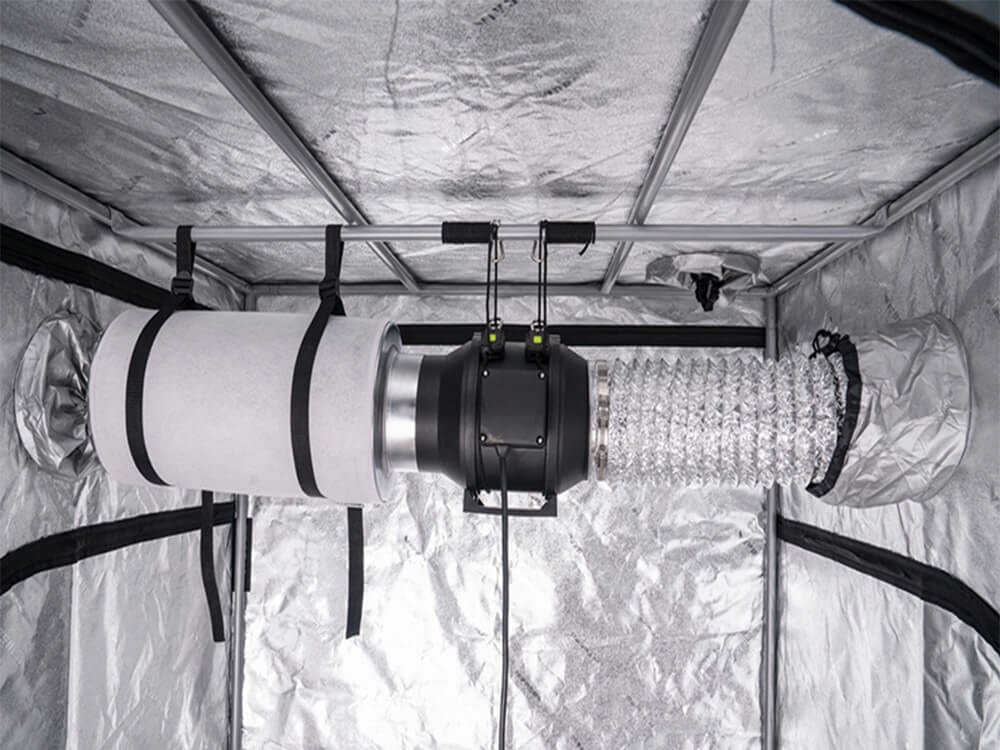
Step 2 — Install the exhaust. Mount the fan at the top of one end of the tent, run ducting from the outlet to outside the grow area, and add a carbon filter inline to control odor.
Step 3 — Set up the air inlet. Cut or open inlet holes at the bottom of the opposite end. An intake fan (same size or one size smaller than your exhaust fan) improves air exchange.
Step 4 — Block light leaks. Use ducting hangers and caulk gaps around fans and ducts; add light-proof mesh or flaps over inlet holes.
Step 5 — Add monitoring. Install a thermometer/hygrometer. Target 70–85°F and 50–70% humidity for most plants.
Step 6 — Add speed control. A speed controller lets you dial in airflow precisely — higher during lights-on, lower during lights-off.
Step 7 — Seal the tent. Zip or velcro the tent fully shut so all air exchange happens through your ventilation system, not through gaps.
Step 8 — Test and adjust. Run the system for a few hours, check your readings, and adjust fan speed or ducting until temperature and humidity land in range.
For a complete guide, check out How to Set Up a Grow Tent Ventilation System to learn how to build an effective ventilation system for your grow tent.
FAQ
Should my grow tent fan run 24 hours a day? Only during the seedling stage. Once plants reach the vegetative and flowering stages, run the fan continuously during lights-on and step it down (or switch to low on oscillating fans) during the dark cycle.
What CFM fan do I need for a 4×4 grow tent? A 4×4 tent has a baseline air-exchange requirement of about 21 CFM. In practice, once you account for ducting resistance, a carbon filter, and heat load, a much higher-rated fan is typically appropriate.
Does a carbon filter reduce my fan's airflow? Yes — plan on roughly a ~60% increase in required CFM to compensate for the added resistance of a carbon filter.
Can I run my exhaust fan on low all the time instead of turning it off at night? Yes, and for oscillating fans that's actually the recommended approach. For inline exhaust fans, a gradual step-down after lights-off is more common, but running continuously on low is a safe alternative if you'd rather not adjust settings daily.
How do I know if my ventilation is strong enough? Track temperature and humidity with a dedicated thermometer/hygrometer. If you're consistently above 85°F or humidity climbs above 70% during lights-on, size up your fan or shorten your ducting run.
Can too much airflow hurt plants? Yes. Excessive or direct airflow can stress plants, especially seedlings and young plants, causing excessive moisture loss or physical damage. Aim for a gentle, consistent breeze that keeps air moving without constantly blasting the leaves, and adjust fan speed based on the plant's growth stage, temperature, and humidity.
Have a specific setup question? Message us on Reddit Community or Facebook Community — we're happy to help you dial in your tent.